The Thermostat Leader
Emotional Regulation · Workplace Resilience · Scenario-Based Learning · Articulate Rise 360
The Thermostat Leader: Emotional Regulation Under Pressure
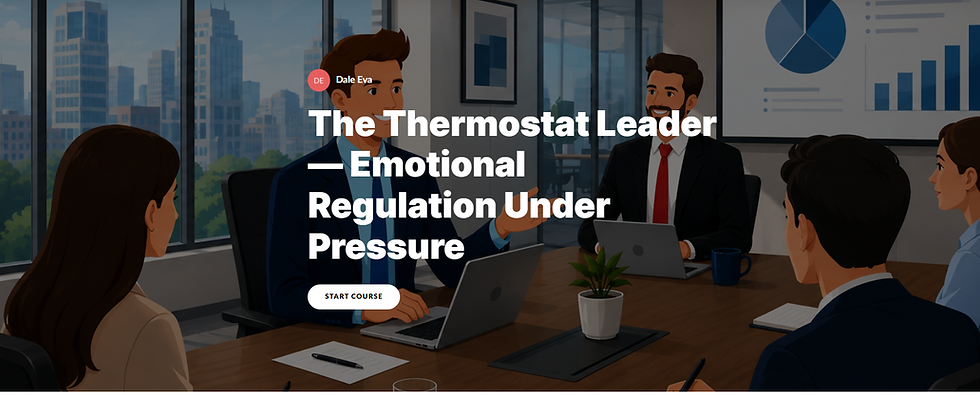
An interactive learning experience designed to help professionals manage emotional reactions, recover more quickly under pressure, and respond intentionally during difficult workplace situations.
TYPE
Interactive eLearning course
AUDIENCE
Professionals working in fast-paced or high-pressure workplace environments
TOOLS
Articulate Rise 360, MightyPlug-in for Rise, Adobe Illustrator, Canva, Google Forms
ROLE
Solo project — instructional design, scenario writing, eLearning development, interaction design, visual design, assessment design, and evaluation design
The Problem

Pressure changes how people communicate. A critical comment during a meeting, an unexpected email, a missed deadline, or feeling excluded from a decision can trigger an emotional reaction before there is time to think through the response.
In those moments, employees may become defensive, shut down, catastrophize the situation, or communicate from frustration rather than intention. Knowing that someone should “stay calm” is not enough.
I designed this course around a more practical question: What can a learner actually do in the first few seconds of an emotional surge — and what can they do next to regain control of the situation?
The Learning Goal
The goal of the course is to help learners move from automatic reaction to intentional response. By the end of the experience, learners practice how to:
-
Recognize early physical and cognitive signs of emotional escalation.
-
Interrupt a reactive response before speaking or acting.
-
Identify common cognitive distortions that intensify workplace stress.
-
Reframe an emotionally charged interpretation more objectively.
-
Maintain composure during direct or uncomfortable feedback.
-
Recover after stressful interactions rather than carrying the reaction forward.
-
Communicate boundaries using clear, regulated language.
The Approach

I designed the course as a progression from: awareness → regulation → reframing → application → recovery. Rather than beginning with abstract emotional-intelligence theory, each module gives the learner something observable to notice or something concrete to do.
Recognize the reaction before trying to control it
The first module focuses on what emotional escalation can look and feel like. A labeled graphic allows learners to explore signs across the body and mind. The purpose is to make an internal emotional experience more visible.
Give learners an immediate circuit breaker
I wanted the course to provide a tool learners could recall during an actual stressful moment. The 6-Second Circuit Breaker turns regulation into a short sequence: Pause → Name It → Somatic Drop → Exhale.

Challenge the story behind the emotion
We don’t react to reality; we react to the story we tell ourselves about reality. The course introduces cognitive distortions—like mind-reading, catastrophizing, and labeling—and asks learners to identify which story is driving their temperature up.
Design Highlights
The Thermostat Metaphor
The thermometer/thermostat comparison became the conceptual anchor for the course. A thermometer simply reflects the emotional temperature around it. A thermostat responds to the environment but also has the ability to influence what happens next. That metaphor supports the central message: Emotional regulation is the ability to choose what you do with emotion.
The Escalating Review

The central scenario places the learner in a higher-pressure situation: receiving blunt, aggressive feedback about their work in front of colleagues during a live call.
The learner can respond in three ways:
Defensive Reactivity
Immediately counter the criticism and defend the work.
Passive Shutdown
Say nothing, disengage from the conversation, and carry the resentment forward.
Regulated Neutrality
Acknowledge the feedback, ask clarifying questions, and move the deeper conversation into a private follow-up.
The purpose of the scenario is not to identify the response that sounds nicest. It asks learners to consider what happens next when they choose to react defensively, withdraw completely, or regulate themselves before responding. The consequences make emotional regulation visible as a workplace performance skill rather than simply a personal wellness concept.
Many emotional-regulation resources focus on the moment of conflict and stop there. I wanted the final module to address what happens afterward. Learners explore how to re-center following an emotionally demanding interaction and how to prevent unresolved frustration from contaminating the next conversation.
Recovery Is Part of the Skill
DEAR MAN for Boundary Setting
An accordion interaction introduces the DEAR MAN communication framework as a structured way to communicate needs and boundaries:
Describe
Describe the facts without judgment.
Breaking the conversation into distinct components gives learners a structure they can return to when emotions make spontaneous communication more difficult.
Express
Express the concern using clear language.
Assert
Assert what is needed.
Reinforce
Reinforce the positive outcome.
Clean vs. Contaminated Communication
A sorting interaction then asks learners to distinguish between regulated and emotionally loaded workplace statements. For example:
Contaminated
Clean
“You never reply on time.”
“I need your review by 2 PM to meet our client deadline.”
The contrast helps learners see that boundary setting does not require avoiding directness. The goal is to remove accusation, exaggeration, and emotional residue while keeping the actual need clear.

Evaluation Strategy
I integrated Google Forms after every module so learner feedback could be connected to specific parts of the experience rather than collected only at the end.

Module 1 — Recognition & Regulation
Feedback focuses on whether learners found the content relevant, whether the emotional-hijack graphic was understandable, and how confident they feel using the 6-Second Circuit Breaker during future stressful situations.
Module 2 — Reframing & Scenario Practice
Learners evaluate the realism of the Escalating Review scenario and identify which cognitive distortion they recognize most often in themselves. This determines whether scenarios reflect credible workplace pressure.
Module 3 — Recovery & Boundaries
The final module feedback examines the Clean vs. Contaminated Communication activity and whether learners envision using DEAR MAN in actual workplace boundary conversations. The focus is on transferring behavior.
SCORM Cloud Tracking
“Did the learner choose to respond differently the next time they felt the temperature in the room start to rise?”
Measuring Learning
- Recognition: Can learners identify warning signs and triggers?
- Decision-Making: Choice of regulated response in high-pressure scenarios.
- Application: Appropriate steps in recovery routines vs contaminated communication.
- Personal Transfer: Identifying personal triggers and reframing strategies.
What I Would Iterate On Next
- Additional branching consequences to the Escalating Review scenario.
- Trigger situations involving email, chat, meetings, and leadership pressure.
- Short pre-course self-assessments to identify behavioral patterns.
- Downloadable Trigger & Reframing Plans for course completion.
- Delayed follow-up surveys to evaluate real-world transfer.
